Bayonets: A Tale of Warfare Evolution
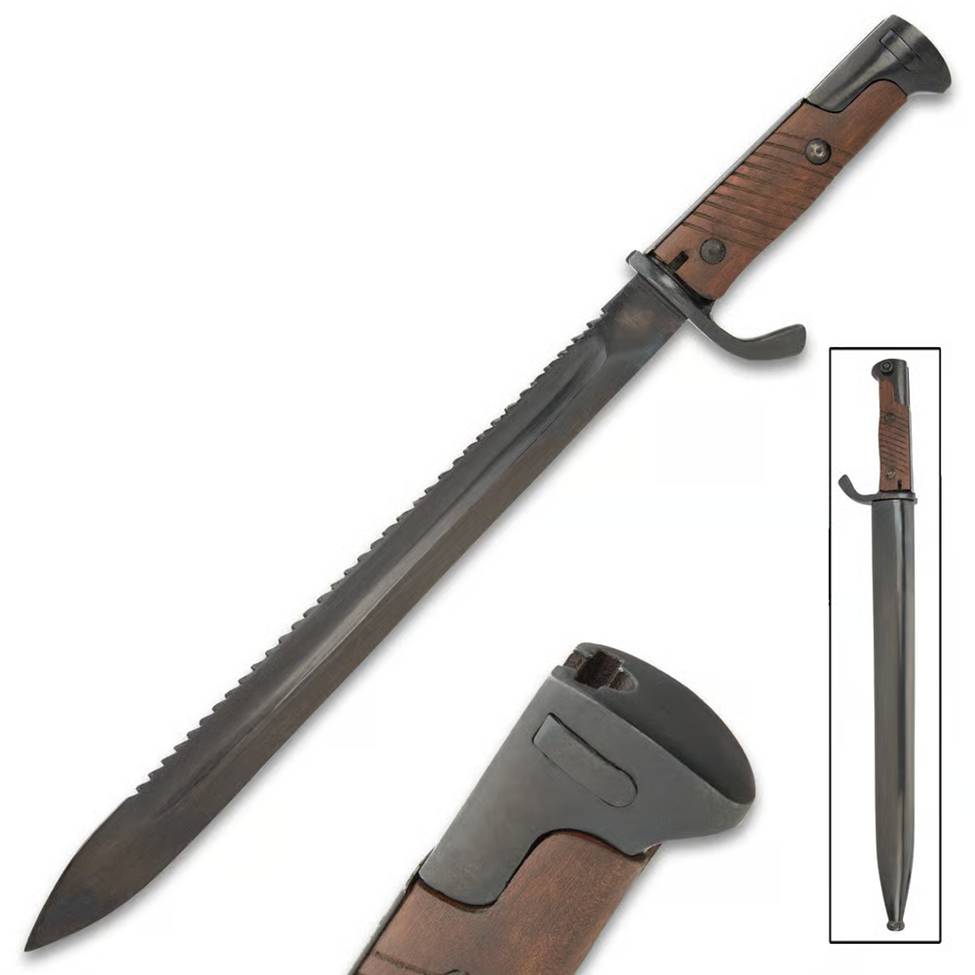
The bayonet has long been a symbol of the soldier’s rugged utility—a tool that doubled as a weapon, a survival implement, and even a psychological edge on the battlefield. Among the most infamous of its kind were the WW1-era German sawback bayonets. These fearsome blades have drawn a mix of fascination and controversy due to their saw-like backs and the grisly rumors surrounding them. But how do these historic bayonets compare to what today’s modern soldiers carry into combat?
The answer lies in understanding not only the design evolution of the bayonet but also the massive transformation of warfare itself over the last century.
The answer lies in understanding not only the design evolution of the bayonet but also the massive transformation of warfare itself over the last century.
The Iconic Sawback Bayonets of WW1 Germany
WW1 German bayonets, particularly the sawback models, were multi-purpose tools born from a military culture that demanded functionality from every piece of gear. These bayonets weren’t issued across the board. Instead, they were selectively distributed to pioneer units, railway engineers, and sometimes machine gun crews. They were designed with dual purposes in mind: combat and engineering. The backbone of these bayonets, the infamous sawback, was originally meant to act as a field tool. In trench warfare, where soldiers were constantly digging, cutting through brush, and building makeshift defenses, the sawback edge was a practical addition. It allowed soldiers to cut wood for fortifications or remove barbed wire obstacles without needing a separate tool. For example, the Pionier-Faschinenmesser M65, introduced in 1865, was both a hacking blade and a combat bayonet.
The Downfall of the Sawback Bayonet
Despite their practical use, sawback bayonets quickly gained notoriety. Allied propaganda portrayed them as instruments of brutality, not tools. Moreover, modern trench warfare evolved rapidly. By 1916, British and French forces began using metal stakes instead of wooden posts for barbed wire. This shift rendered the sawback feature largely obsolete in the eyes of German command. With its utility diminishing and the associated risks increasing, the German High Command ordered the removal of sawbacks from front-line use in late 1917. These removals were done hastily—sometimes in rear-area workshops, sometimes in large depots. As a result, many bayonets show crudely ground-down backs, while others retain the full saw edge. Even after the war, the new German Reichswehr decided to scrap the concept entirely. Although older models like the S.98/05 were still used in modified form, the age of the sawback bayonet had effectively ended.
The Rise of Modern Bayonets: Simplicity Over Sophistication
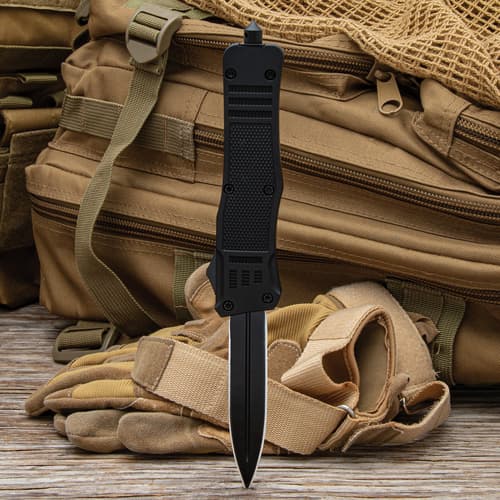
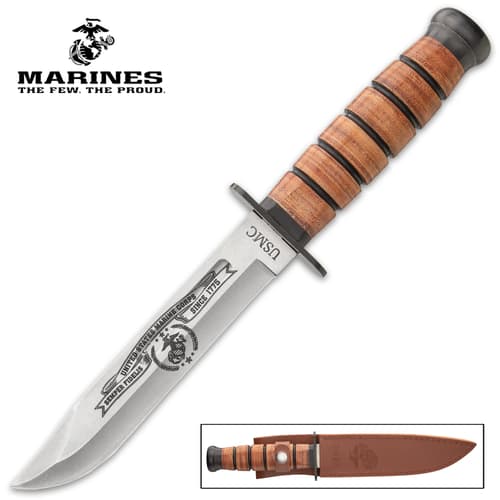
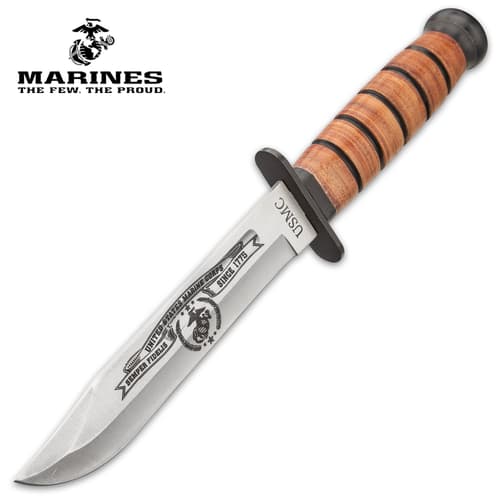
Fast forward to the 21st century, and the bayonet still exists—but it looks nothing like its World War I predecessors. Today’s bayonets are simpler, lighter, and more focused on durability and utility over intimidation. Modern bayonets, like those issued with the M4 carbine or AK variants, often double as knives. Many are designed with hard polymer grips, corrosion-resistant steel blades, and a hollow handle that can be mounted onto a rifle muzzle. The M9 bayonet used by the U.S. military is a perfect example—it serves as a knife, wire cutter (when combined with its sheath), and a bayonet. What’s missing? The sawback. While some modern bayonets include a serrated edge for cutting rope or plastic, none feature the deep, toothy sawbacks of WW1 fame. This change isn’t just a matter of aesthetics, it’s a reflection of how warfare itself has evolved.
Modern Warfare’s Shift: From Trenches to Technology
The biggest reason for the change in bayonet design is the change in how wars are fought. In WW1, the static nature of trench warfare meant soldiers spent much of their time digging, cutting, and constructing. A sawback bayonet made sense—it was as much a tool as a weapon. But today’s soldiers are highly mobile. They operate in urban environments, deserts, forests, and even digital spaces. The need for a saw is now filled by specialized, lightweight gear like multitools, folding saws, and dedicated entrenching tools. Moreover, close-quarter combat has changed dramatically. Soldiers now engage enemies with firearms at longer ranges, supported by drones, guided missiles, and air support. Hand-to-hand combat, while still possible, is extremely rare. The bayonet has become more of a backup weapon, something you carry "just in case" or use in ceremonial roles rather than daily field use. Even when used, the bayonet’s role is mostly psychological. Training with it can build aggression and confidence. However, its battlefield utility is minimal compared to WW1.
From Brutal Edges to Multipurpose Tools
Today, bayonets are designed with an eye toward weight, ease of use, and legal implications. The idea of carrying a blade that could provoke enemy retaliation or diplomatic outrage is unthinkable in modern military doctrine. Instead, simplicity and utility rule the day. Modern bayonets have transitioned from offensive weapons to multi-role tools. The emphasis is no longer on aggression but adaptability. A modern infantryman is rarely expected to use a bayonet in a charge. Instead, they might use their bayonet to pry open crates, cut paracord, or even prepare a campsite. The shift mirrors the overall transformation of modern military doctrine: precision, speed, and intelligence over brute force. While it’s unlikely the world will ever return to the mass bayonet charges of the past, the bayonet still holds symbolic and practical value. Whether worn during a ceremonial drill or carried as a last-resort survival tool, it remains an enduring piece of military tradition—shaped by history, molded by modern needs.