Machete and Knife Grinds Explained
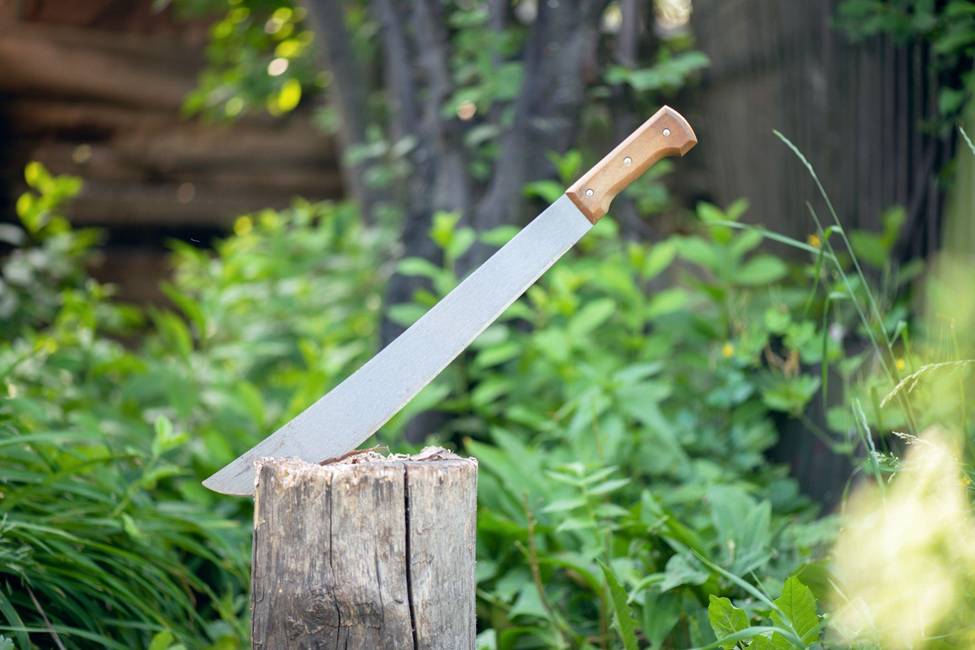
Though you might not have realized it, your machete or knife has a specific grind that influences how effective it is at cutting through meat, chopping through wood, and how hard it will be to maintain and sharpen. This basic post will go through (but will not cover all) of the most common machete and knife grinds.
Full Flat
A full flat grind is a type of grind in which the grind starts at the spine and slopes downward, in a straight, uncurved line, to the edge of the knife or machete. It is more common in knives than machetes, but it is found in both. Because a flat grind has no curvature, restoring the edge is relatively simple. It also offers considerable strength and can produce a very fine edge that is fairly easy to resharpen. Because of the simplicity of a flat grind, it can produce either a very thin, razor sharp blade, or a somewhat thick, stout blade with an obtuse edge that is long-lasting, even though it isn’t quite razor sharp.
The full flat grind is one of the best grinds for slicing, especially in wood, because it does not bind as easily as a hollow grind and because both sides are evenly ground, so one side doesn’t necessarily want to “dive” into the medium, which occurs with some asymmetrical grinds, like chisel grinds. Flat grinds cut very well, are easy to maintain, and are relatively easy to resharpen, blade steel aside. With that said, they don’t slice quite as well as hollow ground blades and don’t last as long as saber grinds (not covered here) or convex grinds, which we will cover shortly.
Half Flat (Scandi)
The half-flat grind, also (and more commonly) known as a Scandinavian, or “Scandi” grind, is fairly common on both machetes and knives. It is just what it sounds like: instead of the grind starting at the spine and tapering in a straight line down to the edge, it starts about halfway up the side of the blade and then tapers to the edge. It can also start a little closer to the edge. In a Scandi grind, there is no secondary bevel at the edge. The first bevel tapers all the edge to the edge, producing a surprisingly sharp and fine edge. However, a lot of metal is left behind the edge, which reinforces it.
It is also the case that more metal is left in the stock of the blade between where the spine and where the grind starts. That makes a Scandi grind particularly robust. Because there is no secondary bevel, you can lay the flat of the grind directly against the stone to sharpen the edge, without taking into account the angle of the secondary bevel (because there is none). The chief advantage of the Scandi grind is in the strength, but the drawback is that Scandi grinds don’t slice as efficiently as full-flat grinds or some other types of grinds.
Hollow
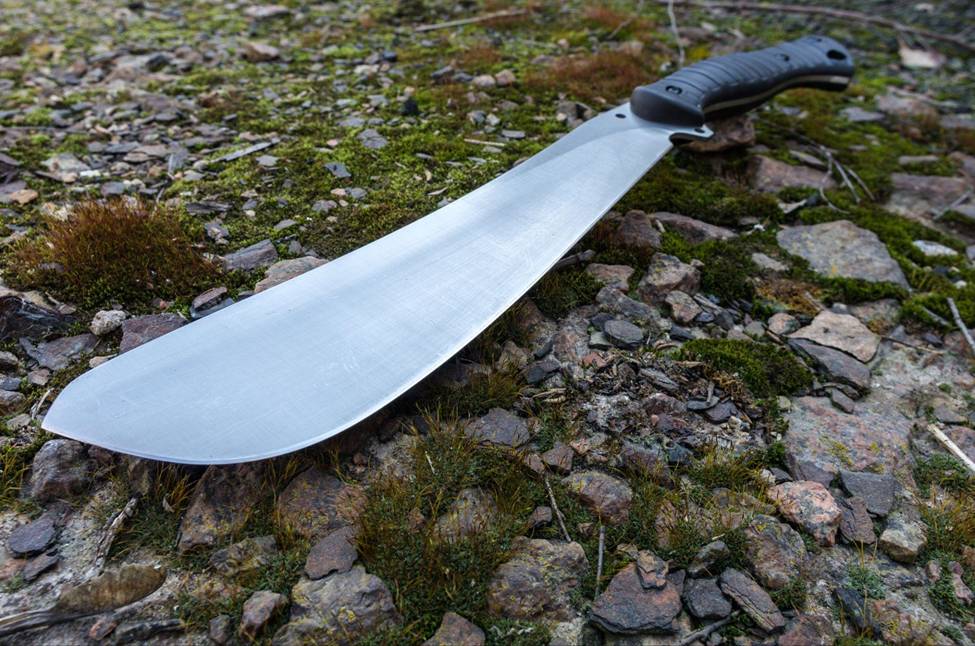
A knife with a hollow ground knife, in cross section, has a grind that curves inward toward the blade stock. This produces a very fine edge that can be exceptionally sharp. As a result, it is commonly found on hunting knives (like Buck knives) and on straight razors, but is very uncommonly encountered in machete profiles. A hollow ground blade will slice very efficiently through soft material, such as meat, so as a result, hollow ground blades are common for butchering and meat processing. This is also the reason that many hunting knives are hollow ground.
The flipside is that in hard materials, like wood, a hollow grind will bite deep and then bind in the material as the rest of the blade stock comes into contact with it. As a result, axes and machetes, along with other blades destined for woodworking, almost never have hollow ground blades. The other consideration is that the very fine edge, and thin bevel, of a hollow ground blade, are both very, very fragile. They dull quickly and can easily be chipped or forced to roll. Therefore, hollow ground blades generally require more frequent resharpening than knives with flat or Scandi grinds.
Convex (AKA Ax Grind)
The convex grind, also called an ax grind because it is common on axes, is the most common grind found on machetes and other knives designed for chopping, like cleavers. It is in practice essentially the opposite of a hollow grind. Whereas on a hollow ground knife the grind is concave, and bends inward to the blade stock, on a convex ground blade, the “cheeks” of the grind bow outward, away from the blade stock. Though you can ultimately produce a fine edge, the grind is very robust and results in an edge that can take a lot of abuse.
The convex grind is therefore best adapted to axes, machetes and knife patterns that are intended to be used as choppers. This is not only because the grind produces a robust edge that is unlike to chip or roll, but because as the grind is forced into a material it wedges the material apart, making it highly effective for chopping and splitting. The drawback of the convex grind, despite the fact that it produces an excellent chopper or splitting with a strong edge, is that it can be difficult to resharpen, since the grind typically does not have a secondary bevel. Therefore, you need to match the grind at the edge in order to restore it when sharpness is lost. Otherwise, it is a highly effective grind profile for axes, hatchets, tomahawks, machetes and knives that are intended to be used as choppers, splitters, or for other hard work.
Here for a New Machete or Knife?
Need a new machete for clearing the yard and processing fuel, or just a new knife for the collection? You’re in the right place either way. Take a look through our catalog and get in touch if you have any questions about any of the specifications of our machete and knife patterns.