4 American Bayonet Patterns You Should Recognize
4 American Bayonet Patterns You Should Recognize
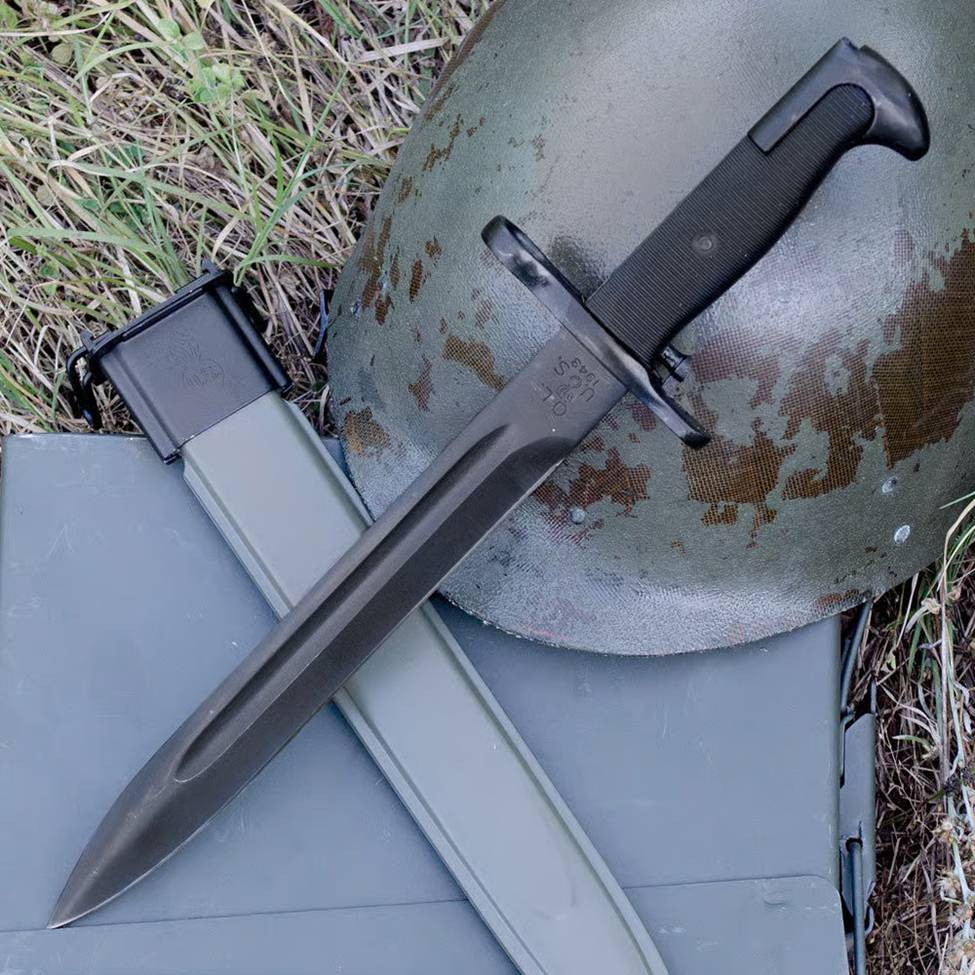
There are many infamous bayonet patterns from history, and we carry many in our collection, not all of which are American; some of our replicas are British, German and Japanese. But we represent a slice of American history in our collection of bayonet replicas, and 4 interesting patterns are well-represented. If you’re a fan of American military history, you should recognize them. They are the M1905, the earliest of the bunch, followed by the M1, M7 and the M9 bayonet that replaced it, in that order.
Here’s your primer on each.
The M1905 Bayonet
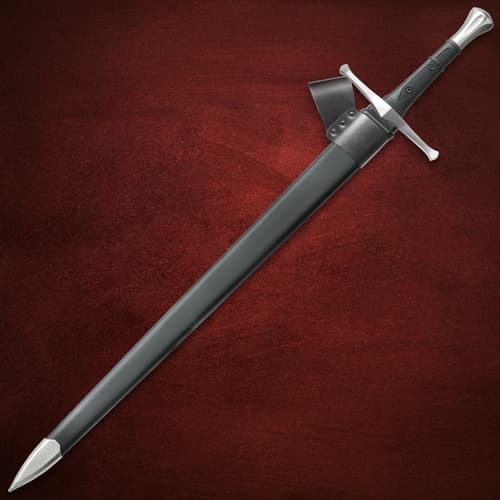
The M1905 is an American pattern from the early 1900s, and which was designed for use with the M1903 Springfield. This was technically standard issue during the First World War, even though shortages required that most Americans were actually armed with Enfield rifles. The M1905 was a sword-style bayonet, with wood or plastic grips and a 16 inch blade. Sword bayonets had longer blades which afforded the user greater reach when the rifle was used as a sidearm, and the combatant with the longer blade often had an advantage. However, in the trench warfare of WWI, that length actually became a disadvantage and limited mobility. Nonetheless, these sword pattern bayonets remained in production through the First World War, and the M1905 remained compatible with the M1 Garand rifle; no major changes were made to the design until the Second World War.
The M1 Bayonet
The M1 bayonet was an evolution of the M1905 which necessitated a shortening of the blade. Given the constraints of close-quarters combat, and the fact that newer, gas-operated semi-automatic battle rifles were not as limiting as their bolt-action predecessors, reach in some scenarios was more of a hindrance than a benefit. As a result, by 1943, the Army started shortening the blades of M1905 bayonets by grinding them down to 10 inches, which considerably reduced the overall length and weight of the M1905. Consequently, the M1 and M1905 are effectively the same in all other respects. Like the M1905, the M1 had either walnut wood or phenolic resin grips attached to the handle; interestingly, the M1 was not called so for its compatibility with the Garand rifle of the same name, but was simply following the Army’s naming convention. Between 1943 and 1945, more than 2 million original M1 bayonets were produced, on top of the M1905 models that were shortened to convert them to M1 models.
The M7 Bayonet
Introduced in 1964, during the Vietnam War, for the relatively new (at the time) M16 rifle, the M7 bayonet was a highly versatile and utilitarian tool that could not only be used as a bayonet on several models of battle rifles and shotguns, but detached and used as a fighting knife or a utility knife. The M7 was similar to one of its predecessors, the M4, and sported a 6.75” spear point blade along with a larger muzzle ring and a two-lever locking mechanism to secure it to the rifle’s lug. About 3 million of these have been manufactured for service. Relatively simple in design, this model consists of the blade stock, two scales that are secured via grip screws and washers, and two lever locks and a helical compression spring that secure the hilt to the bayonet lug of select firearms, among them the M16, the M4, and certain Mossberg shotguns.
The M9 Bayonet
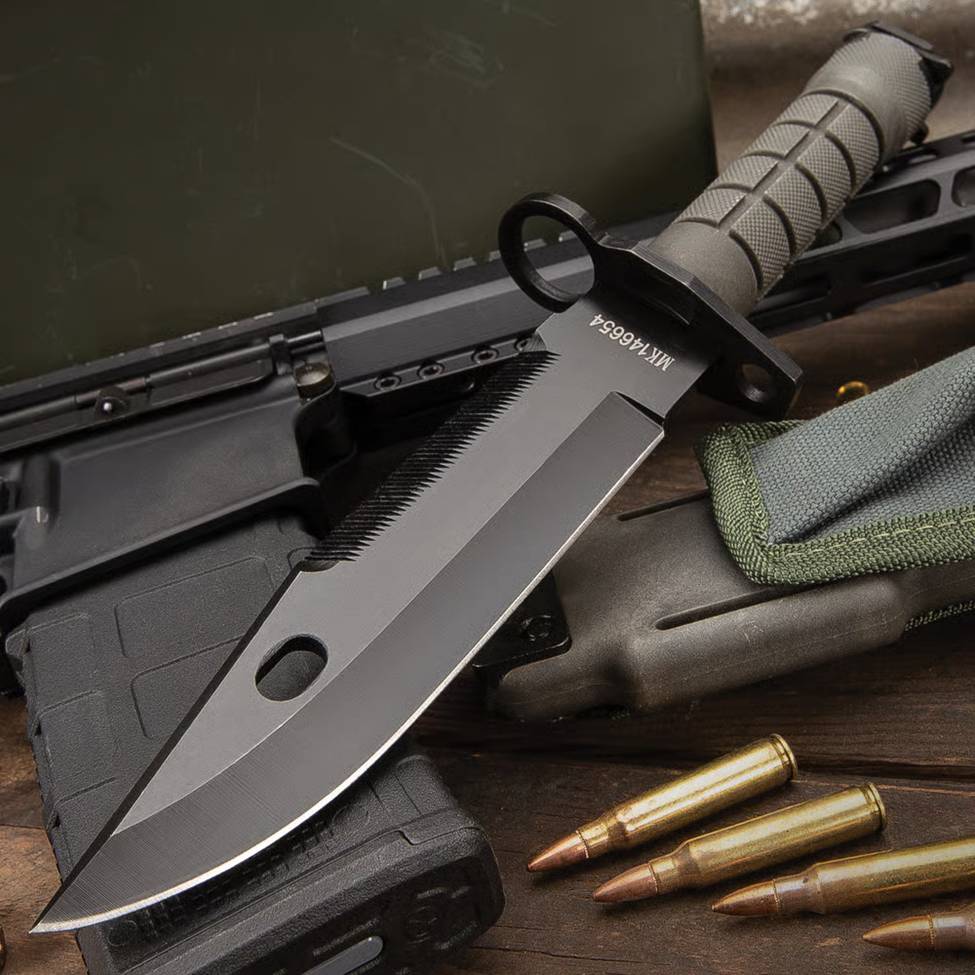
The M9 bayonet was developed to replace the M7 bayonet and so was also developed for compatibility with the M16 rifle. It was adopted officially in 1986. The M9, interestingly, has a somewhat curious history as well as a unique response among users. It was larger and heavier than the M7 it was intended to replace, which was not met altogether with approval. Also, some argue that it was “over-designed” so to speak, by trying to accomplish too many objectives.Intended to be a highly utilitarian multi-purpose tool in addition to a bayonet and fighting knife, this bayonet was designed with serrations on the spine, and a hole in the blade corresponding to a lug on the sheath to which it could be attached and used as wire cutters, among other uses. However, the serrations are too shallow, and not sharp enough, to be effectively used on most materials, and the over-specialization of the blade in some ways has served as a drawback. Nonetheless, it remains a popular bayonet especially with collectors and military history enthusiasts
Explore These and Other Bayonet Replicas in Our Collection
In the market for some new bayonet replicas? Whether or not you collect American military reproductions, we carry a number of historically significant patterns here, including Arisaka Type 30 and Seitengewehr M98 replicas, among others. Check out our collection and get in touch with us if you have any questions about our collection.